


Chants of “We won’t go back!” echoed from the front of Los Angeles City Hall, as women and allies held up signs reading, “Women’s rights are human rights,” “My body, my choice,” and “Abortion is healthcare.”
On Monday, June 24, elected officials, community leaders and activists joined the Women’s March Foundation for a policy discussion on reproductive rights at the foundation’s headquarters in Boyle Heights, followed by a rally for reproductive freedom in front of City Hall.
The gathering took place on the second anniversary of the Dobbs v. Jackson Women’s Health Organization Supreme Court decision that overturned Roe v. Wade and returned abortion decisions to the states.
“We have to continue to fight back, but also be vocal, be visible. Because it is imperative that we get back reproductive rights,” said Emiliana Guereca, founder of the Women’s March Foundation. “Democracy fails when it fails women, and it fails women first.”
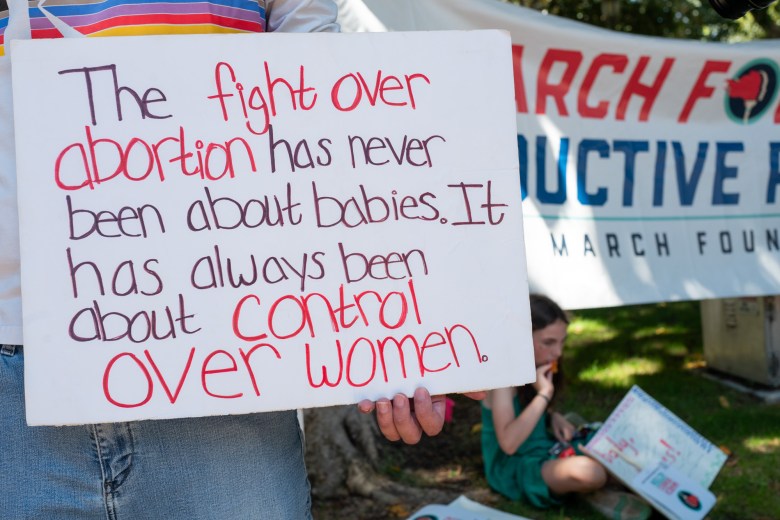
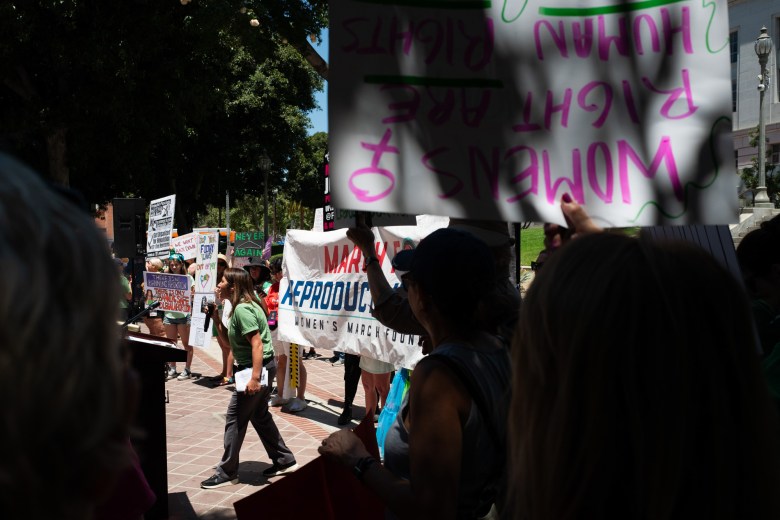
Emiliana Guereca, founder of the Women’s March Foundation, speaks at a reproductive rights rally in front of Los Angeles City Hall, June 24. (SFVS/el Sol Photo/Semantha Raquel Norris) 
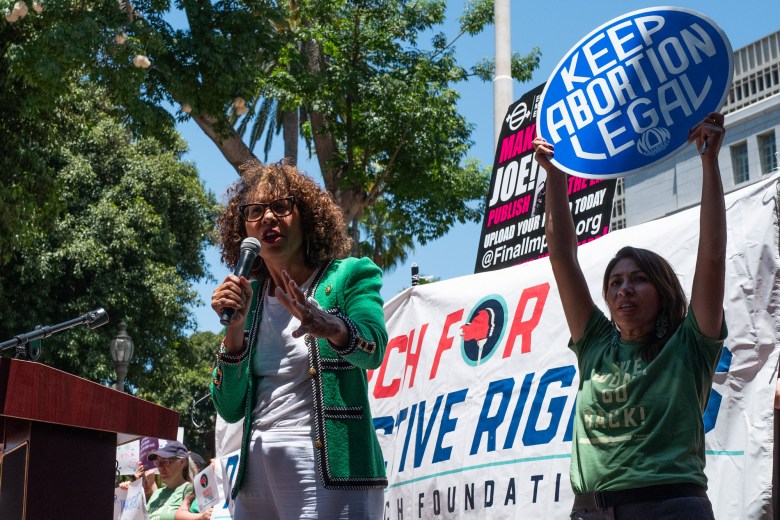
Congresswoman Sydney Kamalger-Dove speaks, June 24. (SFVS/el Sol Photo/Semantha Raquel Norris) 

Senator Alex Padilla speaks, June 24. (SFVS/el Sol Photo/Semantha Raquel Norris) 
Attending elected officials included Sen. Alex Padilla, Congressman Jimmy Gomez and Congresswoman Sydney Kamalger-Dove.
Representatives from Planned Parenthood, Latinas for Reproductive Justice, TransLatin@ Coalition, Equal Means Equal, WMF Feminist Majority and Uprising LGBTQ also participated.
Reproductive Rights is Access to Healthcare
The rally was a stop on Secretary of Health & Human Services Xavier Becerra’s national Reproductive Health for All tour.
“In order to restore Roe, we need a federal law to be passed by Congress,” said Becerra. “Without restoring that federal protection, that federal right, women throughout this country are going to continue to suffer.”
“It’s not just abortion that’s being denied, it is access to health care period,” he added, noting that reproductive rights include procedures such as egg freezing and IVF (in vitro fertilization).
LA-based attorney Vanessa Gomez underwent fertility preservation treatments. She was relieved when she was able to preserve her eggs, restoring her hope of becoming a mother one day.
“If I wanted to have this procedure today, in any state other than California, I likely would not be allowed to,” said Gomez. “The city, county and state in which you live should not dictate your ability to preserve your option to become a mother. Your socioeconomic status, your political leanings and your background should not dictate your ability to preserve the option to become a mother.”
As more states dissolve reproductive rights, women, trans and non-binary people with reproductive organs living in those states, face worsening health implications.

Secretary of Health & Human Services Xavier Becerra, right, and Congressman Jimmy Gomez, left, attend a policy discussion on reproductive rights at the Women’s March Foundation headquarters in Boyle Heights, June 24. (SFVS/el Sol Photo/Semantha Raquel Norris)
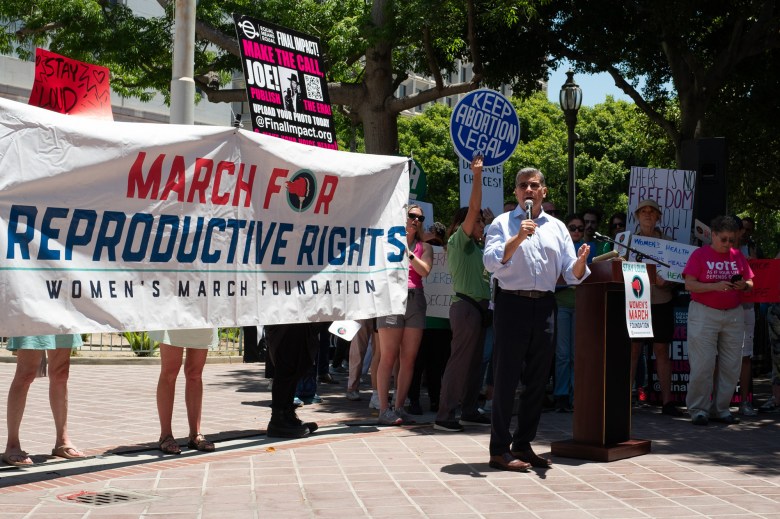
Secretary of Health & Human Services Xavier Becerra speaks at a reproductive rights rally in front of Los Angeles City Hall, June 24. (SFVS/el Sol Photo/Semantha Raquel Norris)
“A woman living in a restrictive state is two or three times more likely to die from a pregnancy than a woman who lives in a state that still offers her the care she needs,” said Becerra. “We know from some of the reports that more than 170,000 women have had to leave their home, leave their community, leave their state, to access the care they need.”
Many of these women travel to states like California, where they can still access that care. Becerra said that these restrictions continue to put strains on doctors and healthcare facilities, including in “sanctuary cities” like LA, which are now overloaded with patients.
“Like my wife who is an OBGYN, no doctor should have to consult with legal opinions before she renders her medical opinions,” said Becerra.
Supreme Court Rules in Favor of Emergency Medical Treatment for Abortions
Becerra forewarned about the U.S. Supreme Court abortion case, Moyle v. United States, which put Idaho’s restrictive abortion laws against the Emergency Medical Treatment and Labor Act (EMTALA).
EMTALA states that no one can be denied emergency medical care from hospitals for procedures that would save their life or stabilize their health. This includes emergency abortions to save pregnant patients, which Idaho argued was against their state abortion laws.
On Wednesday, the court voted 6-3 in favor of reinstating a lower court order that allowed hospitals in Idaho to perform emergency abortions when a patient’s health is at serious risk. The ruling does not fully resolve the issue, as a future case could reappear before the court.
“If this law [EMTALA] were to be undermined, and we no longer have a right to emergency care, then I suspect, I almost can bet you, that a lot of hospitals will say ‘well, you’re not entitled to the emergency care anymore,’” said Becerra.
“For people who are undocumented, if emergency care would be limited, then they would have very few options because most of those undocumented immigrants will not have insurance,” he added.
A Family Issue
“We know that women of color – Latinas, African Americans, Native Americans – are likely going to have the most difficult time getting access to the care that they need,” said Becerra. “Which means a greater chance for bad outcomes, a greater chance that the woman will not have a chance to exercise their choice, and a greater chance that we’re denying some of these individuals a future that they decide how it will look.”

Congressman Jimmy Gomez speaks at a reproductive rights rally in front of Los Angeles City Hall, June 24. (SFVS/el Sol Photo/Semantha Raquel Norris)
Congressman Jimmy Gomez is the sixth child born of Mexican parents. After he was born, in 1974, his mother got her tubes tied, as it was finally legal to do so without permission from her husband. Gomez was appalled at the idea that women could have fewer rights now than his mother did then.
“I never thought Mexico would be moving in a forward direction while the United States was moving in the backward direction,” he added, noting that Mexico elected its first female President and has federally protected abortion laws.
Gomez founded the Congressional Dad’s Caucus and continues to advocate for men to walk beside women in the fight for reproductive rights.
“Latino communities have traditional values of family, but they also value the mother,” said Gomez. “When it comes to the Latino community, this is an issue that they should care about, because it is essentially about family, and having other people trying to tell you what to do about that family.”
“People and their doctors, not politicians, should have the freedom to make their own health care decisions.”
Rallying for Rights in an Election Year
“A woman’s right to choose and a woman’s right to reproductive rights should not be politicized,” said Guereca.
She said the Women’s March Foundation was rallying to, “demand policy changes, and [call for] lawmakers at all levels of government [to] take action to restore and protect reproductive rights.”
“It is an election year and we need to make sure that we vote the correct people into office,” she added. “Women will decide this election.”
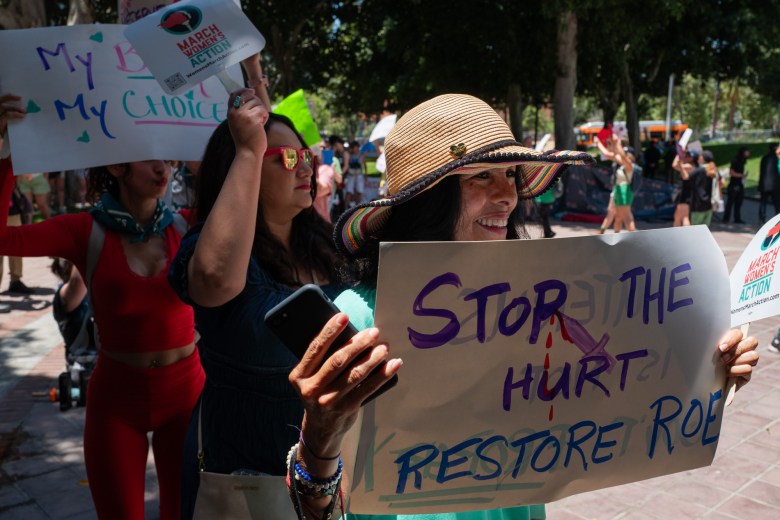
Xiomara Flores-Holguin has been attending these rallies for women’s rights since 2017 because she fears losing her fundamental rights.
“I made a choice about my body, but I want the future [generations] to have that choice,” said Flores-Holguin. She added that this is just the beginning, fearing that next, “They’re going to come after other civil rights.”
“It’s a wake-up call for everybody,” she said. “Men, women, all people of color. We have to wake up. We have to do something.”